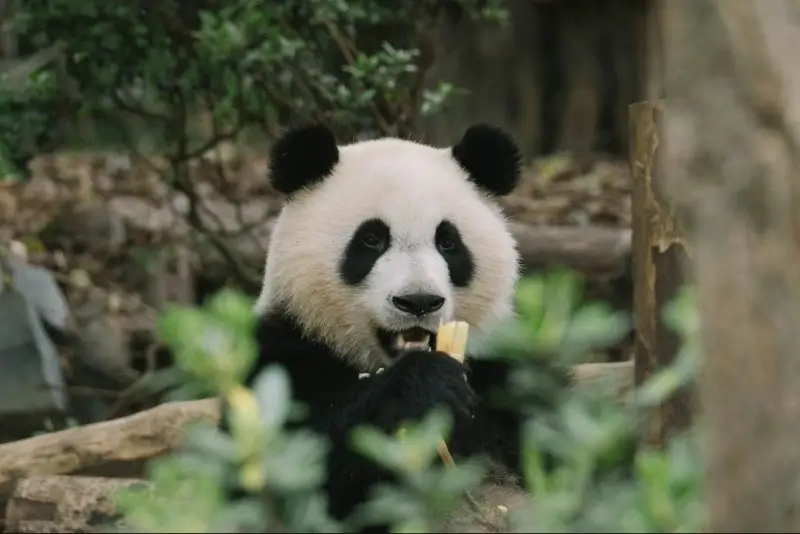
In the heart of the Qionglai Mountains, where mist settles over the deep valleys in the morning and lifts only towards midday, two hundred thousand hectares of ancient forest and dense bamboo groves stretch across the landscape, a place where time seems to lose its measure and the forest appears to live by its own laws. This is Wolong – the Crouching Dragon – a name that seems to belong more naturally to the mountain itself than to a world in which life unfolds according to laws of its own. Established in 1963, Wolong was the first sanctuary for giant pandas in China, one of the earliest places where people recognised that this creature needed, above all, the space to remain what it was: wild.
In the heart of the Qionglai Mountains, where mist settles over the deep valleys in the morning and lifts only towards midday, two hundred thousand hectares of ancient forest and dense bamboo groves stretch across the landscape, a place where time seems to lose its measure and the forest appears to live by its own laws.
The giant panda is, in essence, a living paradox, a species whose body still bears the traces of an evolutionary path that carried it in an almost contradictory direction. This mammal, which belongs to the order Carnivora, evolved approximately two million years ago into an almost exclusively herbivorous animal, with bamboo making up between ninety-five and ninety-nine per cent of its diet. An adult panda consumes between twelve and thirty-eight kilograms of bamboo each day and may spend up to fourteen hours chewing, simply to obtain the nourishment it needs. Its digestive system, however, has remained largely that of a carnivore, while the bacteria in its gut are poorly adapted to breaking down the cellulose in plants.
Almost the panda’s entire existence revolves around food: finding bamboo, chewing for hours, resting, and beginning again, following the demands of a body that can extract only a small proportion of the energy it needs from what it eats. For the rangers, however, the traces left behind in the forest become precious signs of an animal they may spend days searching for without ever seeing.
Contrary to the impression of them as solitary bears, giant pandas have a more complex social world than we tend to imagine. Recent studies have shown that they communicate through a varied repertoire of vocalizations and scent signals. During the mating season, males travel considerable distances in search of a mate, while females produce calls that can carry for several kilometers. For much of the year, however, they retreat into the solitude of the bamboo groves, sharing their territories with other pandas and occasionally meeting in playful encounters and moments of closeness that reveal a less familiar side of the species.
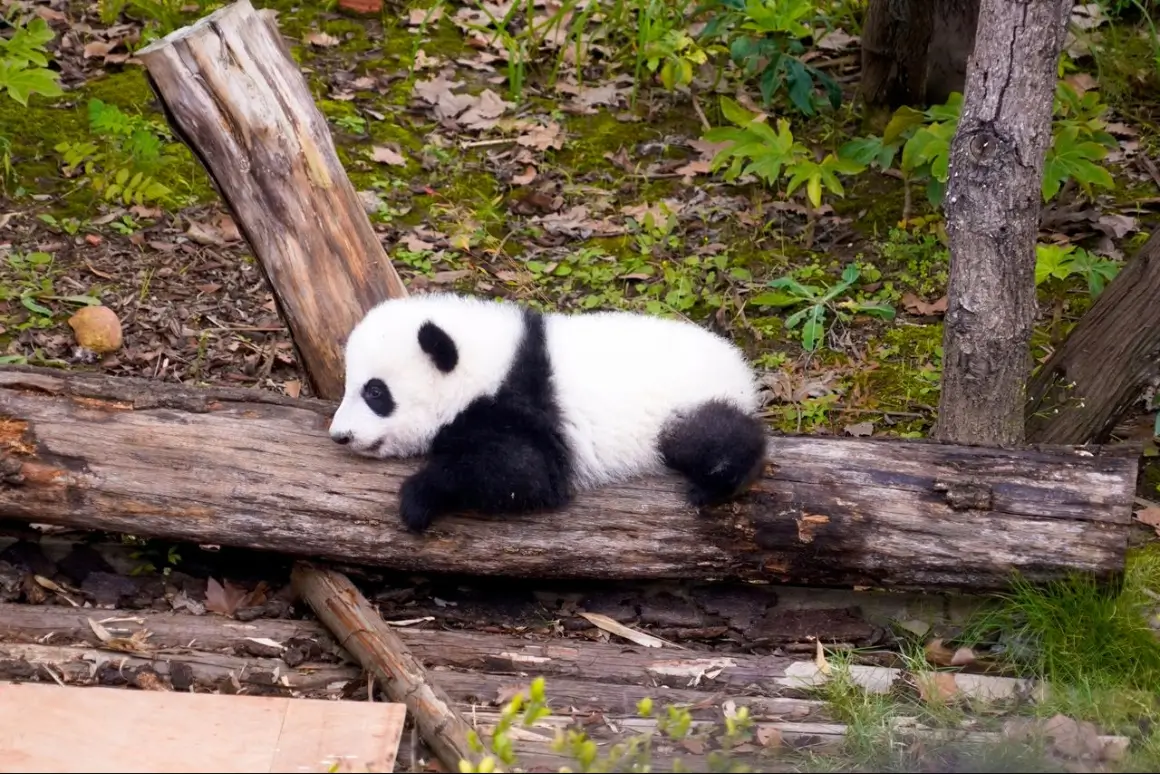
Cubs remain with their mothers until they are two or three years old, learning from them how to chew bamboo and how to find their way, little by little, through a world where survival is learned through observation and patience. This social side of the panda is among the least understood aspects of the species, for these animals are notoriously difficult to observe in the wild, and those who protect them, such as Shi Xiaogang, see them only in brief and precious moments of closeness, moments that can remain with the person who witnessed them for years to come.
This digestive inefficiency is only one of the species’ many vulnerabilities. Its gestation is unusually short for a bear, and cubs are born weighing between ninety and one hundred and thirty grams, roughly the size of a stick of butter, utterly defenseless. Females may give birth only once every two years. In the wild, such a slow reproductive pace makes every individual matter, and the loss of each one carries a particular weight.
It is from this fragility that a story of survival has emerged, one that has unfolded over more than six decades, written slowly in the forests. In the 1970s, the first national census estimated that fewer than 2,500 wild pandas remained in China. The population continued to decline, falling to 1,114 in the 1980s, while in Wolong only 104 remained. Behind these figures were deforestation, poaching and the fragmentation of habitat, forces that steadily narrowed the world in which the panda could live.
Today, after decades of quiet work, the figures tell another story: 149 pandas in Wolong and 1,864 across China. In 2016, the International Union for Conservation of Nature reclassified the species from Endangered to Vulnerable. The change came after decades of patrols, monitoring and habitat protection, after years in which people continued to enter the forest, follow tracks and wait, often without knowing whether their efforts would ever be rewarded by so much as a glimpse of the animal they had come to find.
In the wild, such a slow reproductive pace makes every individual matter, and the loss of each one carries a particular weight.
To understand Wolong, you have to know Shi Xiaogang, a man for whom the forest has been, for more than three decades, a workplace, a place of danger and, in some quiet way, a home. Now fifty, he is head of the Mujiangping Protection Station. His day begins before six in the morning, when, carrying a twenty-kilogram rucksack, he sets out into the wild. His team, usually made up of ten rangers, spends more than two hundred days a year in the most remote parts of the reserve, on patrols that can last for up to two weeks, far from any trace of civilization and every ordinary comfort.
For more than three decades, landslides, avalanches and encounters with wild animals have been part of the reality of a profession rarely glimpsed from beyond the mountains, a profession whose rewards are found in things almost invisible: a fresh track, a stretch of forest left undisturbed, the knowledge that somewhere deep in the woods, an animal is still alive.
Shi came here in 1992, immediately after graduating from the Sichuan Forestry School. He worked on the third and fourth national panda surveys and has never left. For more than three decades, landslides, avalanches and encounters with wild animals have been part of the reality of a profession rarely glimpsed from beyond the mountains, a profession whose rewards are found in things almost invisible: a fresh track, a stretch of forest left undisturbed, the knowledge that somewhere deep in the woods, an animal is still alive.
In June 2017, during a routine patrol, Shi and the fifteen rangers in his team were attempting to cross a mountain pass at an altitude of 5,500 meters, where the snow lay two meters deep and the wind was blowing with almost unbearable force. Through the thick fog, they could barely see one another. One of the rangers called out to make sure no one had fallen behind, and his voice carried through the mountains. Almost immediately, a deep rumble announced the collapse of an enormous mass of snow. Shi managed to throw himself beside a rock and cling to it, surviving the avalanche but sustaining injuries.
The lesson of that day stayed with him: at high altitude, the human voice can become a danger, and the mountain demands a silence that those who venture into it must learn to respect.
For Shi, encounters with pandas are rare. In three decades of patrolling, he has seen them only twice, and precisely because they were so rare, those encounters have meant more to him than any distinction or recognition.
The first came in 2004 or 2005, when he was searching for wild pandas to film for the National Forestry Administration. After days of searching without success, a rustle in the bamboo caught their attention. They turned and saw a large panda about six meters away, hidden among the trees. The animal ran, and the rangers set off after it, in an unexpected game of hide-and-seek through the bamboo that left them all smiling. Shi remembers that they came close enough to almost touch its tail. Eventually, both sides grew tired – the men and the panda – and for a few moments they sat on the ground and looked at one another, in an encounter where, for a brief while, the forest seemed to suspend the distance between the one who searches and the one being sought.
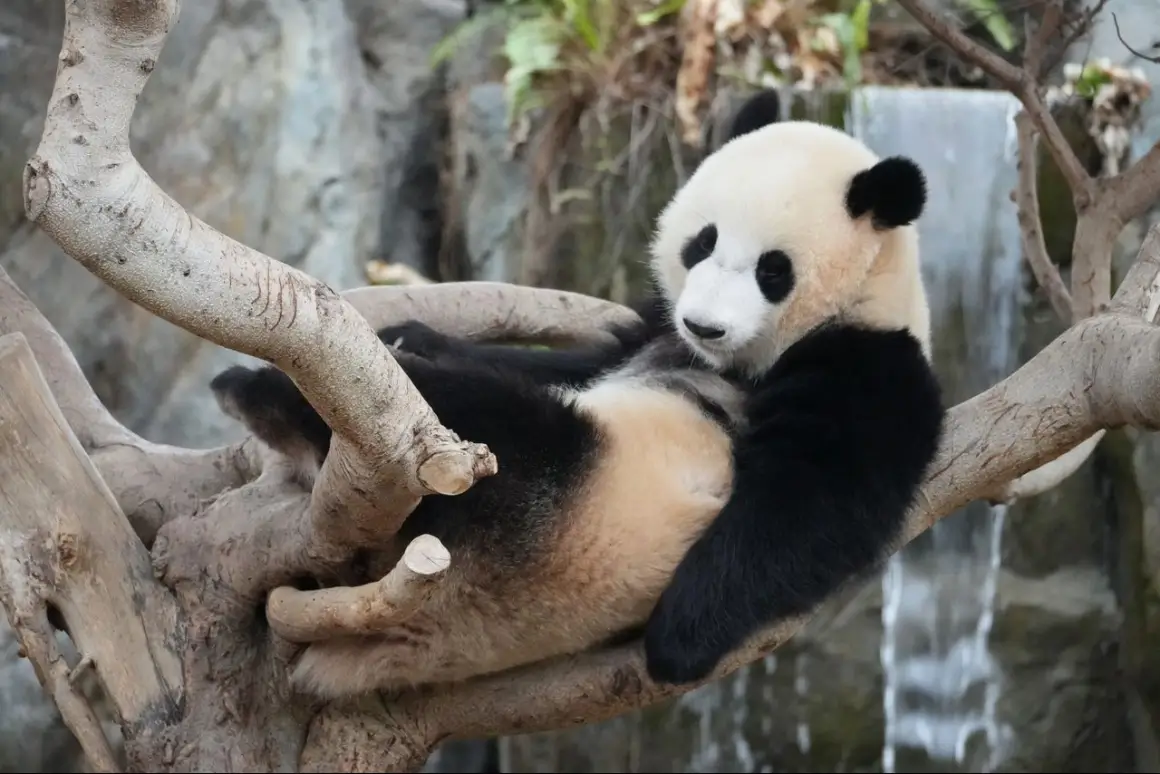
The second encounter was with a cub asleep on a branch, an image of almost unreal gentleness that remained with Shi as one of those rare moments when the wild allows a human being to look without disturbing what they have come to see.
And then there is Zhang Li, a young woman who came to Wolong as a volunteer immediately after university and never left. At first, she had come for a six-month placement, but the first time she saw a panda cub in the flesh, nestled in its mother’s arms in a quiet corner of the forest, she understood that the encounter would change the course of her life.
Eighteen years later, Zhang Li is the coordinator of the panda cub monitoring program, and each morning finds her deep among the bamboo groves, listening to the sounds of the forest and following the traces left by the smallest and most vulnerable of the sanctuary’s inhabitants. She has witnessed births, kept watch beside mothers as they nursed their young, and followed the cubs as they grew, gradually learning to chew bamboo, climb and venture farther and farther from the places where they were first sheltered.
And then, one day, they leave, because every animal raised in the wild must, in time, find its own way.
Wolong is more than a sanctuary for pandas; it is a refuge for an entire living world whose existence unfolds around them. High in the rocky mountains, at elevations of more than 4,000 meters, the snow leopard keeps watch, a rarer and more elusive presence, yet one equally dependent on the integrity of this ecosystem. This predator, its spotted coat like a mantle that disappears against rock and snow, is one of the clearest indicators of the health of the region’s entire food chain.
In the same forests live Tibetan macaques, appearing in noisy groups among the branches, snow deer moving gracefully through the deep winter snow, rare birds nesting in crevices in the rock, and a thousand other species that together form a living whole, in which the existence of each depends upon the existence of the others.
For Shi Xiaogang, Zhang Li and all those who watch over Wolong, patience has become a condition of survival. In the bamboo forests, time seems to pass differently, while their work is measured in days spent in the mountains, in tracks followed through snow and bamboo, in nights far from any trace of civilization and, sometimes, in the simple knowledge that an animal has passed that way and that the forest has received it once more into its depths.
For Shi Xiaogang, Zhang Li and all those who watch over Wolong, patience has become a condition of survival.
In October 2021, the Giant Panda National Park was established across the provinces of Sichuan, Shaanxi and Gansu, connecting habitats that had previously belonged to seventy-three separate nature reserves, with almost seventy-two per cent of China’s wild pandas now falling under the protection of the park. Rangers are equipped with infrared cameras and GPS devices, while the species’ DNA database continues to grow. In 2021, Shi’s team received special recognition at the IUCN International Ranger Awards, and Kathy MacKinnon, Chair of the IUCN World Commission on Protected Areas, spoke of their work as essential to global conservation efforts. Technology has entered the forest, but the essence of the work remains unchanged: presence, observation, patience and time.
Beyond the figures, the distinctions and the technology, there remains a simple truth, older than any conservation strategy: every wild creature has the right to live its life in the place where it was meant to live. A panda searches for bamboo, rests after hours of chewing, seeks a mate, raises its cub and disappears once more into the forest, following the quiet completeness of its own existence.
Some may see the panda as a creature destined for spectacle, but its existence belongs to a world of its own, with its own place in the balance of the forest. The snow leopard, the snow deer, the Tibetan macaques and all the other creatures that share this planet with us possess the same right, each carrying within it a part of the fragile balance of the world to which we also belong.
This is one of the lessons Wolong offers to those patient enough to look closely: the value of wild life does not depend on its rarity, its beauty or the place human beings have assigned to it in their imagination. Every creature has the right to exist in its own way, in its own habitat, following the course that nature has given it.
And those who watch over this place, Shi Xiaogang and Zhang Li among them, together with all those who have devoted their lives to the sanctuary, are, in the end, the guardians of that right. The forest gives them their work, their dangers and their sense of purpose, while their responsibility is to preserve enough space for the wild to follow its own course.
When a panda is born in the wild, in the heart of Wolong’s bamboo forests, it does not know that it is rare, that it is protected, or that it has become a symbol. It knows only the hunger that sends it in search of food, the thirst that draws it towards water, the warmth of its mother and the weariness that calls it to rest, and in all of these lies the same simple, ancient desire to remain alive.
This desire to live, in its purest form, is perhaps the oldest thing we share with every other creature on this planet. When we recognize it in them, we begin to understand that life belongs to us no more than it belongs to them, and that the freedom of a wild creature sometimes begins precisely at the moment when a human being learns to take a step back.
And in the deep silence of Wolong, among bamboo, stone and mist, perhaps protection means, sometimes, simply allowing the forest to remain wild and the animal to remain free.
Wolong is a place where people have slowly learned to take that step back, to look less and leave more room for the wild life around them. A place where the forest can remain a forest and the animal can remain an animal, without being turned into spectacle.
The true measure of protection lies in how many wild creatures we have had the wisdom to leave at a distance, free to follow their own course. And in the deep silence of Wolong, among bamboo, stone and mist, perhaps protection means, sometimes, simply allowing the forest to remain wild and the animal to remain free.
Sources
Wild population (China) Fourth National Giant Panda Census – State Forestry Administration of China (2015) . Via China Embassy 🔗
Wild population (Wolong) DNA-based population study – Wolong National Nature Reserve (2021) . Via China Daily 🔗
Conservation status IUCN Red List of Threatened Species – International Union for Conservation of Nature (2016) . Via IUCN 🔗
National Park establishment State Council approves establishing national panda park – State Council of the People's Republic of China (2021) . Via Ministry of Ecology and Environment 🔗
Ranger profile – Shi Xiaogang Walking the wild side – Shi Xiaogang's 30-year career in Wolong – China Daily (2022) . Via China Daily 🔗
Ranger award (Special Commendation) IUCN International Ranger Awards 2021 – Official Announcement – IUCN World Commission on Protected Areas (WCPA) (2021) . Via IUCN 🔗