Our time runs like a rushing train that refuses to stop in the small stations of life. Our days fall one by one like drops into a greedy hourglass, swallowed before they are ever truly lived. We no longer know how to pause and savor each moment; we rush toward an uncertain tomorrow, forgetting that wealth hides in the present, and that life itself is nothing but a play of destiny — a sun that rises only to set too soon.
But sometimes, we find a photograph. One that reflects in the retina like a transparent mirror, penetrating deep into the soul like an emotion that refuses to leave.
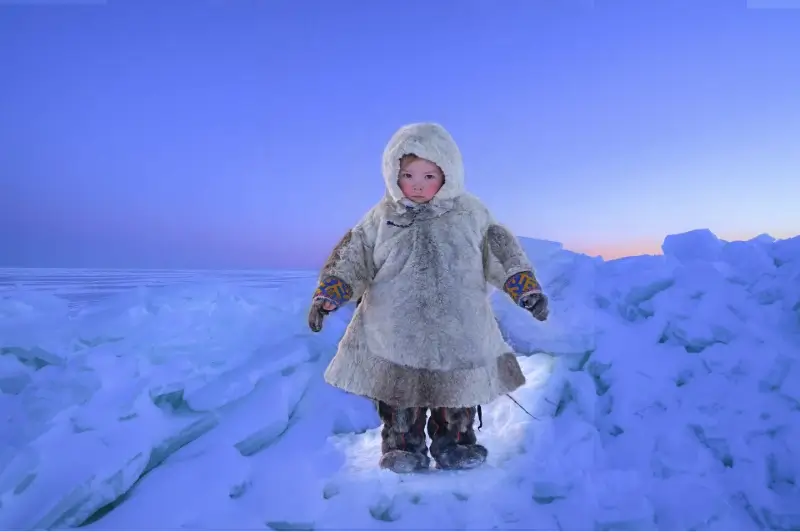
I found one wandering through the vast plains of the internet, where thousands of images shine hollow, like fruits without flesh. I stopped at the face of an Inuit child, cheeks red from wind and frost, dressed in traditional garments, smiling with such innocence and purity that it seemed the vastness of ice was his home, and the wind his closest friend.
What does this child know about happiness, while we — immersed in the noise of the world — have forgotten what it means to truly be happy?
When Cold Becomes Home
For a moment, let us see the world through his eyes. For him, cold is not an exception — it is the essence of days themselves. His red cheeks are not wounds, but the seal of an ancient friendship with the frost.
This relationship goes back more than a thousand years, to the Thule culture, which migrated from western Alaska across the Arctic around the same period in which Norse explorers reached Greenland. They did not flee the cold. They settled inside it.
In the Arctic, humans did not build walls against nature. They learned instead to inhabit its palms, listening to its breath.
What we see as survival was, for them, simply life. Traditional Inuit societies placed far less emphasis on private land ownership and rigid hierarchy than most agricultural civilizations. Instead, they developed strong systems of cooperation, where hunting was not merely domination, but also a form of exchange governed by respect, reciprocity, and survival.
In Inuit cosmology, concepts such as sila and inua express the idea of a living relationship between humans, animals, weather, and landscape — a world animated by presence rather than separation.
To live is to remain in endless dialogue with these forces — to respect them, to thank them.
And perhaps this child, with his red cheeks and angelic gaze, knows what we have long forgotten: that man is not the master of the world, but its guest.
Seal Skin and Ancient Memory
The garment he wears is not decoration. It is technology — a sacred text written in seal skin, stitched with bone marrow needles, a philosophy of survival turned into clothing.
The igloo, contrary to popular imagination, was only temporary shelter. The real Inuit home was often the qarmaq, built from stone, turf, driftwood, and animal skin, heated by the qulliq — a stone lamp burning seal fat.
In its trembling light, women sewed, men prepared tools, and elders told stories. Clothing did not merely cover the body — it connected generations.
Inuit women were engineers of silence. Every stitch had to be perfect — so that melted snow would not penetrate and freeze again, endangering life.
“The thread must hear silence in order not to lose its way.”
Each garment is a physical memory. Each layer of fur is a lesson in physics learned through the body long before science gave it a name.
The Wealth of Those Who Do Not Accumulate
I watched his face for a long time. And slowly I understood: his smile was not fleeting joy. It was the serenity of someone who does not know he could be unhappy.
In traditional Inuit culture, time was not experienced primarily as linear progress, but through recurring cycles of season, migration, memory, and storytelling. For centuries, Inuit knowledge was preserved predominantly through oral tradition rather than written records.
We replaced “to be” with “to have” — and paid for it with borrowed fragments of the soul.
Many Inuit traditions express the idea that hardship is not an interruption of life, but part of its natural rhythm — something endured with dignity rather than dramatized.
True poverty is not the absence of wealth. It is the absence of connection.
Learning to Read Beyond Color
We live in an age where images multiply endlessly, but their stories disappear. A photograph without narrative becomes only a beautiful shadow.
Every image carries a trace — of place, wind, light, and memory. But above all, of the gaze that received it.
This Inuit child represents an entire philosophy: a world that chose harmony over resistance, belonging over possession.
And yet this world is melting — not metaphorically, but literally.
The true journey is not to arrive somewhere, but to encounter something that makes you forget time itself.
I searched through a thousand images. Only one remained: an Inuit child with red cheeks from the cold, who did not know he could be unhappy.
Perhaps the child remained within me through the redness of his cheeks touched by frost, through the immense silence surrounding him, through the serenity resting in his gaze like an ancient light preserved beneath the snow.
His face carried the quiet certainty of belonging, the feeling that human life still moved in harmony with wind, ice, memory, and season, as though the earth itself continued to breathe through those who listened carefully enough.
Somewhere along the path of progress, our century drifted away from this intimacy with time. Days became numbers, distances became speed, and memory slowly lost the warmth of presence. We learned to cross the world while forgetting how to inhabit it.
The photograph opened no distant territory before my eyes. It uncovered a forgotten chamber of human memory, a place where silence still possessed meaning and where belonging resembled a form of peace deep enough to make even the cold feel like home.