In Anhui Province, on the eastern edge of China, time takes on a dense, almost tangible presence. Here rises Huangshan, the Yellow Mountains, a granite massif carrying within its folds one hundred and forty million years of geological history and three thousand years of history written by the human hand.
There is no beginning to this story. Or, if there is, it lies deep within the Earth’s crust, where magma slowly cooled and crystallized into colossal blocks of stone, which the passing millennia then carved, patiently, under the touch of water and wind. Water was the first to write its letters across the massif. It carved canyons, softened edges, opened deep fissures through which light now enters like light entering a cathedral. The wind came later, with its invisible chisel, polishing surfaces, shaping contours, transforming the rock into a landscape that seems drawn by a hand older than any civilization. Granite has always answered these touches. Locals speak of the Five Wonders of the massif: pines that appear to have been shaped by an unseen calligrapher; rocks bearing faces and ancient legends; a sea of clouds that swallows and reveals the peaks like a breathing tide; hot springs long sought for their healing properties; and winter snow, which transforms the mountain into another world. Lotus Peak rises 1,864 meters above sea level, accompanied by Three Piles Peak, Five Elders Peak and Rooster Rock. Each name tells a legend, and each legend leaves behind another page of history.
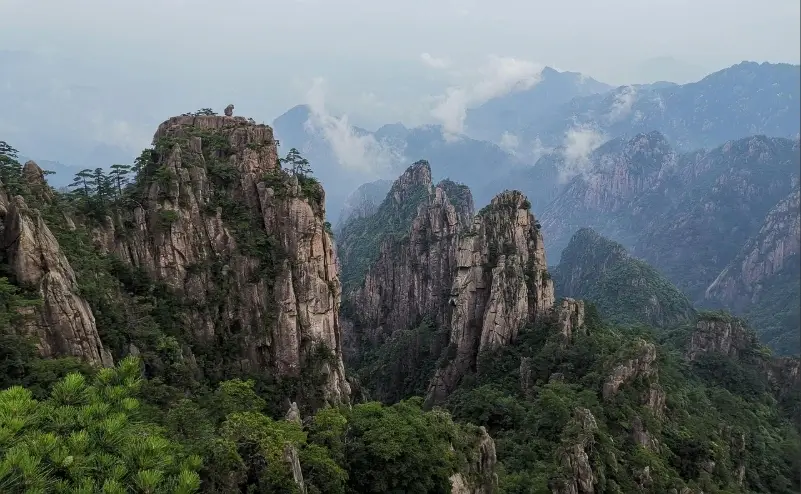
A granite massif carrying within its folds one hundred and forty million years of geological history and three thousand years of history written by the human hand.
Legend tells of the Yellow Emperor, Xuanyuan, one of the Five Emperors of Chinese mythology, ruler of earth and fire, who found immortality here. In his search for the elixir of life, he climbed these rocks until his body was released from the earth and disappeared into the light, leaving behind a sacred place where the boundary between human and divine became so thin that it seemed woven from silk. From then on, Huangshan came to be regarded as a mountain of immortals, a place where the boundary between human and divine could become so delicate that it seemed woven from mist. Other legends tell of the Five Elders who became rocks, of dragons transformed into pine trees, of goddesses who descended to drink from the springs at the foot of the mountain. Every stone, every tree, every thread of mist carries a story passed down by village elders to children through the long winter nights.
Huangshan came to be regarded as a mountain of immortals, a place where the boundary between human and divine could become so delicate that it seemed woven from mist.
People came to these lands thousands of years ago. The earliest communities settled at the foot of the mountain, in villages that today bear names such as Tangkou and Yungu, where the tradition of tea cultivation has passed from father to son, and wooden and stone houses seem to have grown from the same substance as the mountain itself. These people learned to live under the peaks, to gather tea from the sunlit slopes and to listen to the story told by every rock. For them, Huangshan became an ancestor, a witness to births, harvests and winter nights spent around the fire, when the elders spoke of the Yellow Emperor and of the gods who lived within the mist.
During the Tang dynasty, Emperor Xuanzong performed rituals and left an inscription on Rooster Rock, praying for peace and prosperity. Emperor Qianlong of the Qing dynasty wrote a poem dedicated to Huangshan, speaking of “rocks dancing with the clouds” and “pines stretching their branches like open arms towards the sky”. Each of these emperors felt the same attraction: before a landscape that seemed to have emerged from a world older than their own empires, they understood that power and wealth were fleeting, while the desire to leave a mark for posterity has accompanied humanity since the earliest times. Their inscriptions—some still legible, others almost erased—remain testimony to that same human need to leave a trace before time. In 1990, Huangshan was listed on the UNESCO World Heritage List, recognized for its exceptional natural beauty and its profound influence on Chinese art and culture.
Around the mountain, Buddhist monks built monasteries. During the Tang dynasty, the first temples appeared, hidden within clefts in the rock like swallow’s nests suspended between heaven and earth. The Temple of Purple Clouds, the Jade Peak Temple, the Monastery that Gazes upon the Sea—all were once places of contemplation, where monks such as Xuezhuang would sit in solitude, watching the clouds as they are born and die, learning that their ever-changing course is the only certainty, and that change itself is the only permanence. Some endured for centuries; others fell into ruin, covered by earth and roots. Their places remain sacred, as though the stone itself had preserved the memory of their prayers.
Watching the clouds as they are born and die, learning that their ever-changing course is the only certainty, and that change itself is the only permanence.
Huangshan was also a school for artists. For centuries, Chinese painters came here to try to capture on paper what the eye could see, though the brush could not always render it. The Huangshan School of painting, which flourished during the Ming and Qing dynasties, produced masters such as Jian Jiang, who spent decades on these slopes, painting the same pines in every season, learning how light and mist transform the landscape from one moment to the next. Poets such as Li Bai (701–762) wandered these slopes, and in his surviving verses, with their references to “thirty-two lotus peaks” and “red crags”, one can already sense the dilemma that would later haunt painters: how to capture on paper what the eye can see, but the hand cannot hold? It is said that before this mountain, the brush would often come to a halt out of reverence, never from lack of skill. How can one draw a cloud in motion? How can one capture light as it slips across granite? How can one render the space between two winds? Huangshan allows itself to be lived rather than captured. Perhaps this is why many of the finest Chinese paintings were born from such prolonged contemplation that the artist eventually learned to look beyond what the eye could contain. He looked for so long that, in the end, what settled upon the paper was his own experience of standing before the mountain.
How to capture on paper what the eye can see, but the hand cannot hold?
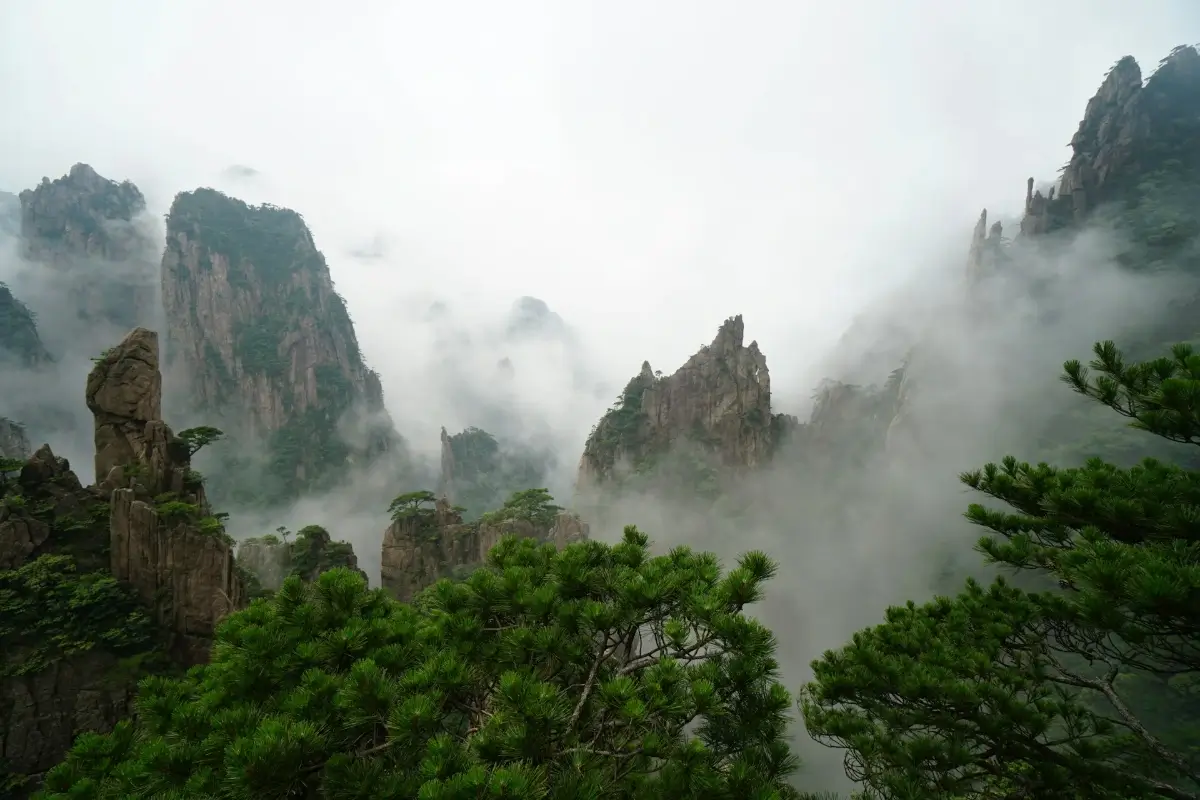
Today, if you wish to climb Huangshan—and sooner or later, you may feel the desire to do so, because the steps are still there, painstakingly carved by generations before you, seventy-two thousand steps ascending through pine forests and passing moss-covered rocks—you will discover an experience that no guide could ever contain in words. You will reach Lotus Peak and watch the sun rise from a sea of clouds, while light spills across the ridges like a wave of molten gold. You will place your palm against the cold granite and may feel that, in the same instant, you are touching the trace of the emperor who carved his name into stone, the gaze of the monk who watched over the clouds, and the gesture of the painter who laid down his brush before a beauty he could no longer contain. Every stone preserves the traces of those who passed this way, waiting, across the centuries, for another gaze to discover them.
You will place your palm against the cold granite and may feel that, in the same instant, you are touching the trace of the emperor who carved his name into stone, the gaze of the monk who watched over the clouds, and the gesture of the painter who laid down his brush before a beauty he could no longer contain.
When you descend from the Yellow Mountains, the mist remains behind, while the mountain’s questions continue to hover above you, like the clouds rising from the valleys each morning. Was it time, faith, or simply a touch that never disperses? What remains is the certainty that, for a few hours, you have been part of a bond humanity has sought for thousands of years: the meeting of heaven, mountain and one’s own being.
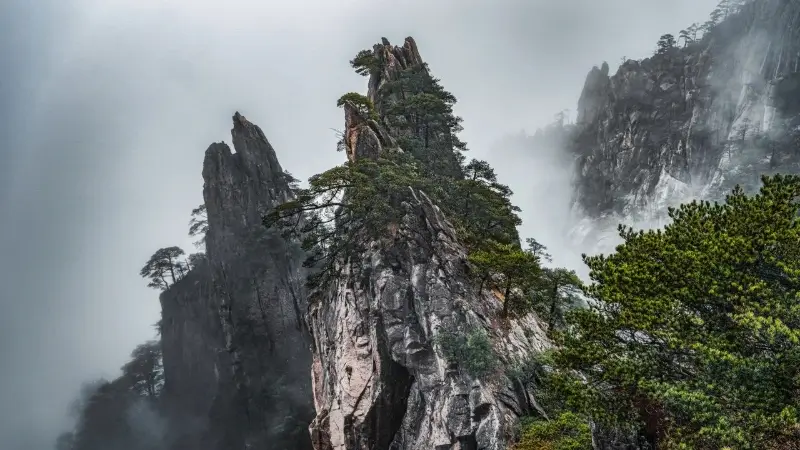
What remains is the certainty that, for a few hours, you have been part of a bond humanity has sought for thousands of years: the meeting of heaven, mountain and one’s own being.