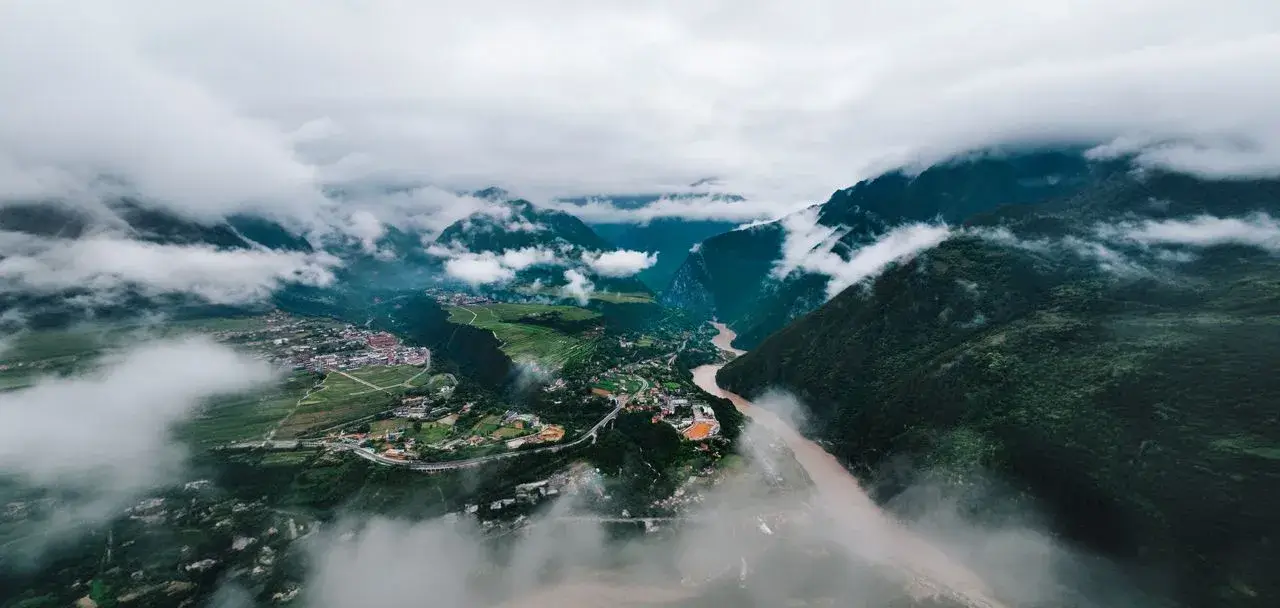
In the south-western corner of China, mountains lift their shoulders towards the clouds, and rivers carve their stories into ancient stone. Yunnan is felt before it is understood. The province draws its beauty from the meeting of mountains, water, forests and the communities that have learned to live among them. Its landscapes seem to look back through time, and the traveler soon discovers that beauty can be found in the first light falling across the rice terraces, in the colour of a sunset that seems to burn slowly, in the face of an old village set between mountain and water.
The hills are clothed in vegetation, their slopes shaped by thousands of terraces carved by human hands over thirteen centuries, rising from the valleys towards the forest like a vast stairway between earth and sky. The villages are living witnesses, and the cultures that inhabit them tell their stories through simple gestures and rhythms carried from one generation to the next. A journey through Yunnan becomes, in this way, a story of light and water, of seasons that transform the same landscape, and of people who have learned to live in harmony with the land they cultivate.
The hills are clothed in vegetation, their slopes shaped by thousands of terraces carved by human hands over thirteen centuries, rising from the valleys towards the forest like a vast stairway between earth and sky.
In the heart of the Ailao Mountains, where the slopes descend at angles that seem to defy the natural contours of the land, the Hani people have shaped, century after century, one of the most remarkable agricultural landscapes created by human hands: rice terraces descending from forested mountainsides towards the Red River valley. In some places, as many as 3,000 terraces unfold between the forests on the ridges and the valley floors, while the entire system extends across 16,603 hectares.
The Hani farmers learned long ago that the land gives in its own time, and that patience is a form of wisdom. Over some 1,300 years, they have developed a system in which water, forest, village and cultivated fields depend upon one another, each playing a part in sustaining the others.
In Yuanyang, during the rainy season, the terraces become mirrors of the sky. Each one catches the light differently: some seem to hold it, while others pass it onwards, creating a visual rhythm between earth and sky. When the farmers flood the rice fields, the mountainsides appear to have gathered the sky into thousands of fragments of water, each changing with the clouds and the light.
The Hani farmers learned long ago that the land gives in its own time, and that patience is a form of wisdom.
In summer, the green is so intense that the eye seems to sink into it as a sea of leaves, while the air carries something of the earth’s vitality. In autumn, ripened rice turns the hills into an ocean of gold, so luminous that the eye can scarcely take in the whole panorama. In winter, when the fields lie bare, the slopes reveal their forms once again, preparing for another cycle.
Here, each season changes the character of the terraces and the way the mountain reveals itself to the eye. Water reflects the sky, green covers the earth, ripening grain turns it to gold, and after the harvest, the simple geometry of the slopes emerges once again. The same landscape, four different expressions.
In autumn, ripened rice turns the hills into an ocean of gold, so luminous that the eye can scarcely take in the whole panorama.
The irrigation system developed by the Hani is a remarkable feat of engineering and ecological wisdom, a network of channels that carries water from the forests on the mountain ridges through the villages and down to the terraces. Forest, water, village and rice fields form a single living system. The forests on the ridges collect and retain the water; the channels guide it towards the terraces; from there, it eventually returns to the rivers, sustaining the landscape through a continuous cycle.
There is a lesson here that reaches beyond agriculture: the Hani learned to follow the contours of the mountain, to work with its slopes and with the water descending from the forests.
In 2013, UNESCO inscribed the Cultural Landscape of Honghe Hani Rice Terraces on the World Heritage List, recognizing a landscape in which agriculture, forest, water, community and belief remain bound together within a living system. UNESCO also emphasises the relationship between the Hani people and their environment, including the spiritual dimension of nature within Hani culture.
Here, Heaven descends into water, water reaches the rice, and the rice returns to the life of the people.
Yunnan is a mosaic of cultures, a meeting place of communities and traditions in which each village preserves its own voice, its own rhythms and its own way of seeing the world.
Shaxi, once an important station along the Tea Horse Road, still retains its medieval character. The weathered stone of Square Street seems to hold traces of a world in which caravans crossed the mountains between Yunnan and Tibet. The Yujin Bridge, spanning the Heihui River, still links the two banks along the old trading route.
At Shaxi, the past is reflected in the architecture, in the stones of the road, in the proportions of the houses and in the way the village continues to be lived in.
Heshun, near Tengchong, is built along the slopes, with small bridges, flowing water and white-tiled roofs that recall the water towns of southern China. Here stands Heshun Library, one of the oldest rural libraries in China, a place where books were once valued more highly than gold and knowledge became part of the community’s identity.
Light enters through the high windows and falls across pages yellowed by time. In such a place, a book seems to belong as much to the person who opens it as to those who preserved it before them.
Xizhou, near Dali, lies at the heart of Bai culture. Its traditional courtyards, with their high gateways and delicate murals, reveal an architecture in which beauty resides in proportion, detail and harmony. The Yan Family Compound is more than an old house: it is a place where the life of a family and the history of a community have met within the same walls.
Baisha, at the foot of Jade Dragon Snow Mountain, is one of the oldest Naxi settlements. Its murals bring together Buddhism, Taoism and local religious traditions in a rare form of syncretism, revealing a spiritual world in which different traditions have shared the same space and given rise to a complex understanding of the sacred.
Nuodeng, hidden among the mountains, is a village where the old rhythms of life remain tied to simple things. The celebrated Nuodeng ham is produced here, smoked and slowly cured over many months in a process that calls for time, care and patience. Beneath the eaves of the earth-built houses, the hams hang as a familiar presence, while the repeated gestures of a community become, without ever claiming to be so, a form of continuity.
Yunnan is a mosaic of cultures, a meeting place of communities and traditions in which each village preserves its own voice, its own rhythms and its own way of seeing the world.
In Yunnan, light changes the way a place reveals itself. At dawn, as the mist lifts from the terraces and light filters through layers of cloud, the mountain seems to emerge gradually from water and air. When the sun rises behind Jade Dragon Snow Mountain and its first rays touch the snow-covered summit, making it shine for a moment, you understand that the sacred can also be encountered through a simple act of looking.
At the Taoist Jindian Temple in Kunming, built entirely of bronze, pilgrims come in search of harmony. The bronze gleams like gold, and one senses that we are only part of a greater whole, a passing presence in a world far vaster than our own lives.
Songzanlin Monastery in Shangri-La, one of the most important Tibetan Buddhist monasteries in Yunnan, is known as the “Little Potala”. Built in the seventeenth century and shaped by the architectural traditions of the great Tibetan monasteries, it rises along the mountainside like a religious fortress, its golden roofs and coloured walls changing the character of the mountain.
Shangri-La itself carries a story of its own. The name, now synonymous with a hidden paradise, was created by the British writer James Hilton in his 1933 novel Lost Horizon. In 2001, the former Zhongdian County officially adopted the name Shangri-La. Today, a name born in literature and a real landscape meet in a place where mountains, Tibetan culture and the Western imagination share the same realm.
Prayer flags, brightened by the wind, add another layer to the scene: their words and symbols are carried through the air, and prayer becomes part of the landscape.
Yunnan is a province you can cross by tracing a line on a map, the deeper journey unfolds between different worlds. You begin in Kunming, descend towards Dali and Lake Erhai, climb towards Lijiang and Jade Dragon Snow Mountain, and eventually reach Shangri-La. As the altitude changes, so do the landscape, the architecture, the people, the beliefs and even the colours of the land.
The rice terraces of Yuanyang, the ancient villages of Shaxi and Heshun, the Taoist temples and Buddhist monasteries each tell a different story, and it is precisely this diversity that makes Yunnan so compelling. Each place preserves a different relationship between people and the land, between community and tradition, between the visible and the sacred.
Perhaps this is the true meaning of travelling through Yunnan: to pass from one world into another without ever feeling that you have left the same province. The traveler leaves carrying every sunrise and every sunset, the reflection of the sky in the flooded terraces, the colours of old houses, the scent of earth after rain, prayers carried by the wind and the faces of people encountered along the way.
And after crossing these landscapes, perhaps you begin to understand why Yunnan dreams in colour. Here, colour belongs to flowers, sunsets and rice terraces; it belongs to people, languages, beliefs, textiles, houses, mountains and to the way each community has left its own imprint upon the same region.
In Yunnan, true beauty reveals itself when you begin to look more closely and understand how many worlds belong to a single landscape.
And when, one morning, the light settles over the terraces of Ailao and the sky is reflected in thousands of steps of water, you will discover its colour.
Only then will you understand why Yunnan has always dreamed in colour.