South America is a continent to be crossed with the soul wide open, like a great initiation suspended between beauty and culture, between the memory of vanished civilizations and the primordial force of nature itself. There are journeys that offer you images of spectacular landscapes, and there are journeys that alter your inner structure forever. South America belongs to the latter category—rare and almost sacred—where every road seems to lead toward a larger, deeper version of oneself.
Brazil, Argentina, Bolivia, and Peru are four states of the human spirit, four emotional geometries that transform the traveler into a witness to the grandeur of the world. Between them flows an invisible continuity, like an underground river linking jungles, mountains, deserts, and cities suspended between past and future. Here, the continent seems to breathe in a rhythm different from the rest of the world—more visceral, more melancholic, more alive.
Everything begins in Brazil, where life appears to overflow simultaneously in all its forms at once. Rio de Janeiro is a sensory explosion, an almost improbable encounter between ocean, stone, and the human spirit. Few places on Earth allow nature and civilization to coexist with such theatrical intensity. Granite mountains rise abruptly from the Atlantic like ancestral deities, and between them unfolds the city itself—frenetic, radiant, restless—beneath the eternal gaze of Christ the Redeemer, arms outstretched as a symbol of peace, hospitality, and humanity’s longing to embrace itself.
Some places do not stay in memory as images, but as shifts in perception.
In Brazil, the drums of the old neighborhoods accompany the very idea of existence. Here, one understands that joy can become a form of spiritual resistance, and beauty, a way of surviving chaos.
At the border between Brazil and Argentina, the Iguaçu Falls assume the role of reminding humanity how small it truly is before the grandeur of nature. No photograph can prepare the eye for that endless spectacle of water plunging into the abyss with an almost biblical roar. There, among liquid clouds and rainbows suspended over the void, one senses that the planet still preserves fragments of the moment of creation itself. The waterfall no longer appears as a natural phenomenon, but as a metaphysical force—a revelation that beauty can become overwhelming to the point of tears.
Argentina emerges like music that suddenly grows slower and deeper. Buenos Aires carries within the same gaze both European elegance and South American melancholy, in a combination impossible to reproduce anywhere else in the world. The city lives through its old cafés, the shadows of long evenings, and through tango, which is not, in essence, a dance, but a conversation about longing, loss, and passion. Argentine tango is not danced, it is lived with one’s entire being.
In the historic quarters of Buenos Aires, there is a persistent feeling that time has not passed, but merely refined itself. Every building carries the nostalgia of a vanished era, and every accordion seems to speak of loves that were never truly forgotten. Argentina does not conquer through exuberance, but through emotional depth. It is a country that slowly enters the soul, like a poem one fully understands only after closing the book.
The true transformation begins when the road ascends toward Bolivia. La Paz, suspended at more than 3,600 meters above sea level, resembles no other city on Earth. It is a place where the sky seems closer than the ground, and where every breath feels like a silent negotiation with one’s own body. Here, the thin air produces a strange form of spiritual lucidity. The city exists between modernity and mythology, between cable cars gliding above steep valleys and ancestral rituals devoted to Pachamama—Mother Earth.
Bolivia preserves something untouched by time. Its markets, the Aymara women in round bowler hats, the scent of burnt wood, and the coca leaves carried against exhaustion create the sensation of a world that has refused to sever itself completely from the sacred. In Bolivia, one travels through successive layers of civilization and memory.
Peru, perhaps, is the continent’s deepest encounter between humanity and eternity. Cusco, the former capital of the Inca Empire, once called “The Navel of the Earth,” is both a historical city and a spiritual center of the Andean world. Its stone-paved streets, perfectly sculpted walls, and the solemn silence of its temples create the impression that the past never truly disappeared. In the Sacred Valley of the Incas, crossed by the Urubamba River, time seems suspended in a golden light, while the mountains become more than geography—they become spiritual presences.
There are places in Peru where one feels that humanity once stood closer to the essence of the universe. Machu Picchu does not diminish that revelation; it magnifies it. The lost city of the Incas impresses not only through its architecture or its impossible position among the peaks of the Andes, but through the silence and energy surrounding it. When the morning mist rises slowly above the stone terraces, one has the feeling of contemplating the traces of a wisdom the modern world has forgotten.
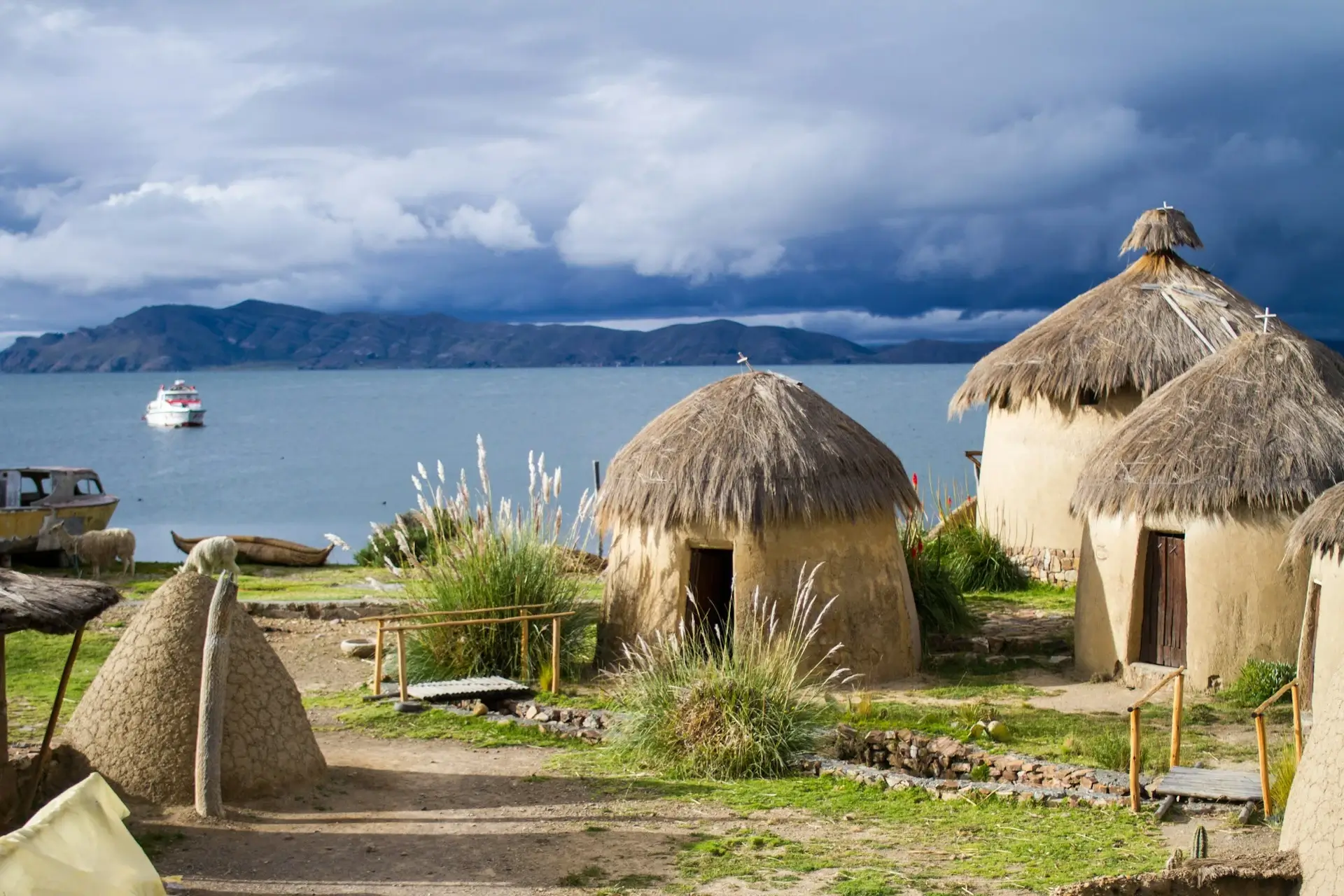
Near the heavens, human beings feel small once again. And perhaps that is precisely what makes them more true. Higher still, upon the deep blue waters of Lake Titicaca—the highest navigable lake in the world—reality takes on the consistency of myth. The floating Uros Islands, built entirely by hand from totora reeds, seem detached from a collective memory older than history itself. There, between water and sky, one understands that adaptation can become art, and fragility can become permanence.
South America offers not only spectacular landscapes, but also intimate confrontations with the ideas of time, nature, and identity. One breathes the cold air of the Andes, tastes the raw and authentic flavors of the continent, listens to the rhythm of tango and Andean drums, and slowly begins to detach from the superficial velocity of the modern world.
A journey through South America becomes, at once, an initiation and an inner transformation.
There are places that give you memories, and places that forever change the way you perceive existence. And South America remains one of the few regions left in the world where humanity can still feel, truly and profoundly, the intense and almost sacred joy of being alive.