Perhaps water does not belong to us, but we belong to it. Perhaps the cry of a newborn child is nothing more than the first memory of the sea from which we came.
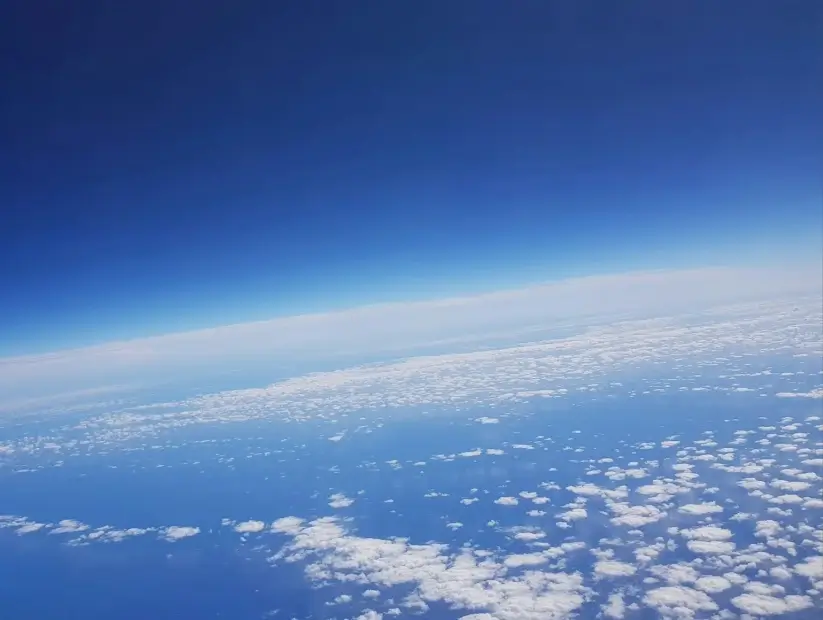
Viewed from space, Earth does not appear to be a continent inhabited by humans, but rather a liquid organism. Nearly three quarters of its surface are covered by water, and this deep blue expanse—crossed by clouds and storms—has become the most recognizable image of our world. The “Blue Planet” is a metaphor for origin, memory, and survival. Perhaps water does not belong to us, but we belong to it. Perhaps the cry of a newborn child is nothing more than the first memory of the sea from which we came.
Long before satellites and digital maps, the oceans represented humanity’s first pathways. Phoenician, Greek, and Arab navigators followed the stars to cross the seas, while in the Pacific, Polynesians managed to travel thousands of kilometers without a compass, guided only by constellations, the direction of ocean swells, and the flight of seabirds. The traditional canoe Hōkūleʻa, launched in the 1970s to recreate these ancient voyages, demonstrated that the great Polynesian ocean crossings were not accidents of currents, but sophisticated acts of astronomical knowledge and maritime instinct. There is a wisdom hidden in the silence of the waves that books have never fully captured.
The sea has never been merely a space to be crossed by ships and vessels. Even today, it preserves the ruins of vanished worlds. Near the coasts of Egypt, the ancient city of Thonis-Heracleion—once a major trading port—was swallowed by the Mediterranean more than a thousand years ago. In Greece, Pavlopetri, considered one of the oldest submerged cities ever discovered, still preserves traces of streets and buildings nearly five millennia old. And the legend of Atlantis continues to fascinate precisely because the ocean seems capable of concealing entire civilizations without leaving almost any trace behind.
How many stories lie in that cold darkness, beyond the reach of sunlight, where time is lost within time itself
There are, however, islands that tell a different story: territories raised from the water by the planet's inner fire. Mauritius, one of the most spectacular islands in the Indian Ocean, is of volcanic origin, formed by submarine eruptions millions of years ago. Today it appears a tranquil tropical paradise, ringed by coral reefs — yet its landscape still bears the marks of craters and mountains born of lava. Beauty is often born of violence, and today's stillness listens still to the distant echo of those primordial explosions.
The oceans are not merely pages of the past; they are also the center of a fragile biodiversity threatened by the carelessness of the present. The vaquita—a small porpoise native to the Gulf of California—is now the most endangered marine mammal on Earth. Fewer than thirty individuals remain, and their decline is linked almost entirely to industrial and illegal fishing nets. What kind of species are we, if we allow silence to replace the final cry of seas and oceans that have never asked anything of us?
What kind of species are we, if we allow silence to replace the last cry of seas and oceans that asked nothing of us?
In tropical waters, the hawksbill turtle, with its golden, translucent shell, survives on the edge of extinction. For centuries, humans hunted it for the beauty of its shell, transforming it into jewelry and decorative objects. Today, ocean pollution, global warming, and the destruction of coral reefs are dramatically reducing its chances of survival. We turned into an ornament what should have remained a living miracle.
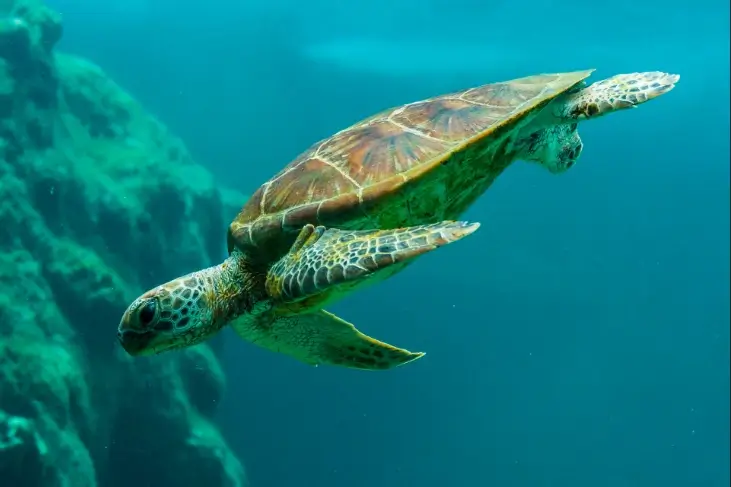
We have turned into ornament what should have remained a living miracle
Have we forgotten that true beauty is not something to possess, but something to contemplate?
And perhaps herein lies the paradox of the Blue Planet: the world that made life possible is the very same world that is slowly being pushed toward imbalance. The oceans absorb excess heat from the climate, swallow millions of tons of plastic, and endure the consequences of modern civilization. Coral reefs bleach, glaciers retreat, and sea levels rise almost imperceptibly, year after year. The planet mourns its loneliness through the rising waters, while we hear little more than the echo of our own pride.
And yet, the sea continues to transmit, quietly, a feeling rare in our age: humility. Before the ocean, we remember that we cannot control everything. Waves erase the boundaries between land and water, storms disregard our affairs, and the depths still hold mysteries that technology cannot fully explain. When you stand on a beach at night and listen to the murmur of the sea, you understand, for just a moment, how small we truly are in the face of its fury.
Perhaps that is precisely why the expression Blue Planet carries such weight. The colour blue reminds us that we are a terrestrial species that depends, in reality, on water — on tides, on rain, on oceans. This blue is a silent call to tenderness, not merely a colour.
And if one day humanity looks once again upon Earth from a great distance, it is unlikely that cities will be the first thing visible. Instead, it will be that immense and delicate blue—the only colour that, so far, has meant life.
And if one day humanity looks once again upon Earth from a great distance, it is unlikely that cities will be the first thing visible. Instead, it will be that immense and delicate blue—the only colour that, so far, has meant life.
Perhaps then we will understand that we are not the masters of this planet, but merely passing guests of its endless blue.